Buying a Condo in the Philippines: 15 Essential Things Smart Buyers Should Know
Buying a condo in the Philippines is one of the biggest financial decisions most Filipinos and OFWs will make — and it’s also one of the easiest to get wrong if you skip the paperwork side of things. Between pre-selling contracts, DHSUD registration, association dues, and title transfer taxes, a condo purchase involves more moving parts than most buyers expect. This guide breaks down the 15 things you actually need to understand before reserving a unit, so you can walk into a sales office (or a Zoom call, if you’re overseas) with real questions instead of guesses.
Buying a condo in the Philippines means budgeting for the unit price plus 6–9% in taxes and fees, verifying the project’s DHSUD registration and License to Sell, understanding your Condominium Certificate of Title (CCT) and association dues obligations, and securing financing — bank loan, Pag-IBIG, or in-house — before you commit to a reservation. Foreigners and OFWs can legally own condo units (not land), subject to the 40% foreign-ownership cap under the Condominium Act.
1. Pre-selling vs. RFO condo: Which Should You Choose?
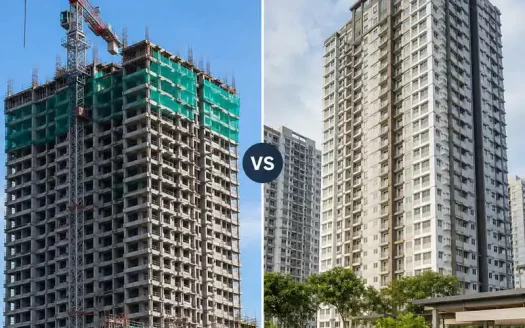
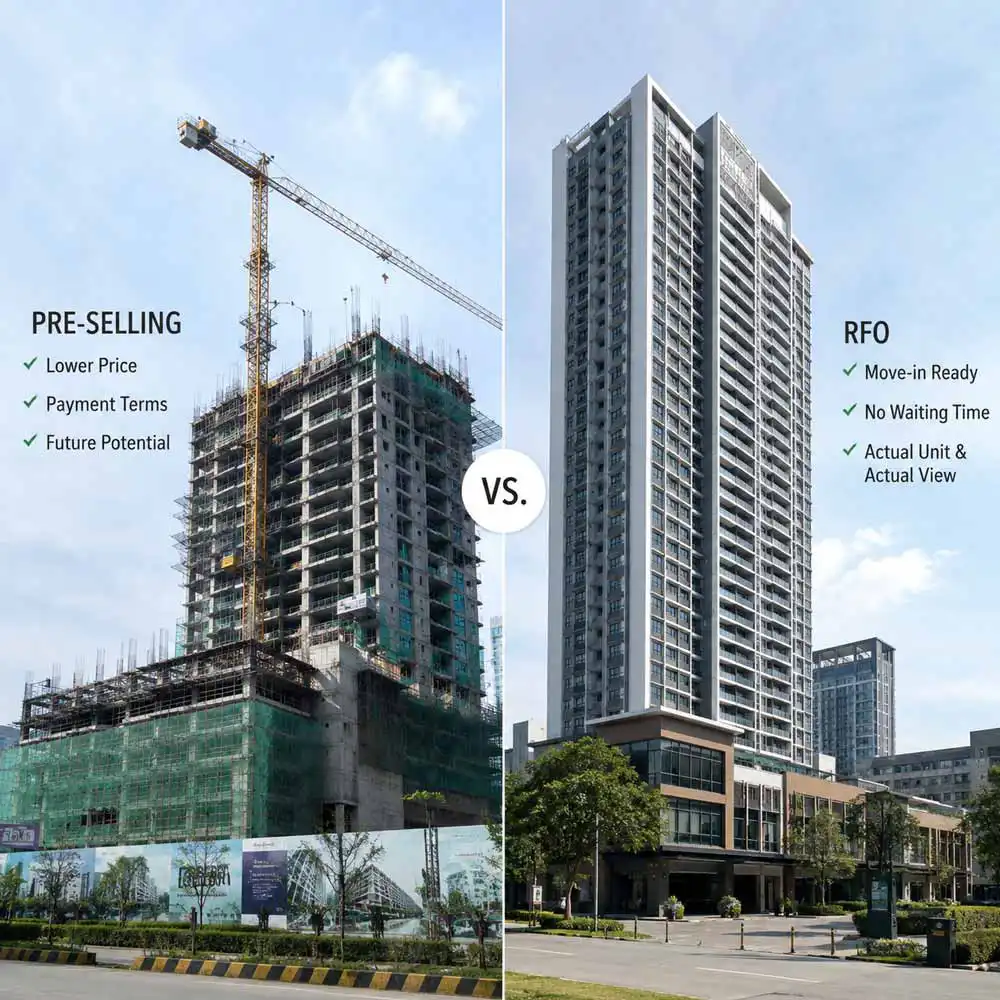
Pre-selling means you’re buying a unit before or during construction, usually with a lower entry price and flexible in-house payment terms spread over several years. Ready-for-occupancy (RFO) means the building is complete and titled, so you can move in or start renting it out right away, but you’ll typically pay a higher price and need financing approved sooner.
Pre-selling carries construction and developer-delay risk — turnover can take two to five years — while RFO carries less uncertainty but demands a bigger upfront cash outlay or an immediately approved loan. Whichever stage you buy at, the project must already hold a DHSUD Certificate of Registration and License to Sell before any developer can legally collect payments or advertise it to the public.
| Factor | Pre-selling | RFO |
|---|---|---|
| Entry price | Lower, often with 0% interest during construction | Higher, reflects completed unit |
| Payment terms | Spread over 2–5 years pre-turnover | Bank/Pag-IBIG loan or cash, due sooner |
| Risk | Construction delays, market shifts before turnover | Lower — you see exactly what you’re buying |
| Rental income | None until turnover | Can start immediately |
2. What Is a Condominium Certificate of Title (CCT)?
A Condominium Certificate of Title, or CCT, is the legal document proving ownership of a specific unit — the condo equivalent of a Transfer Certificate of Title (TCT) for land. When a developer’s Master Deed is registered, the Register of Deeds subdivides the project’s master title into individual CCTs, one per unit, that can be sold, mortgaged, or transferred independently of the rest of the building.
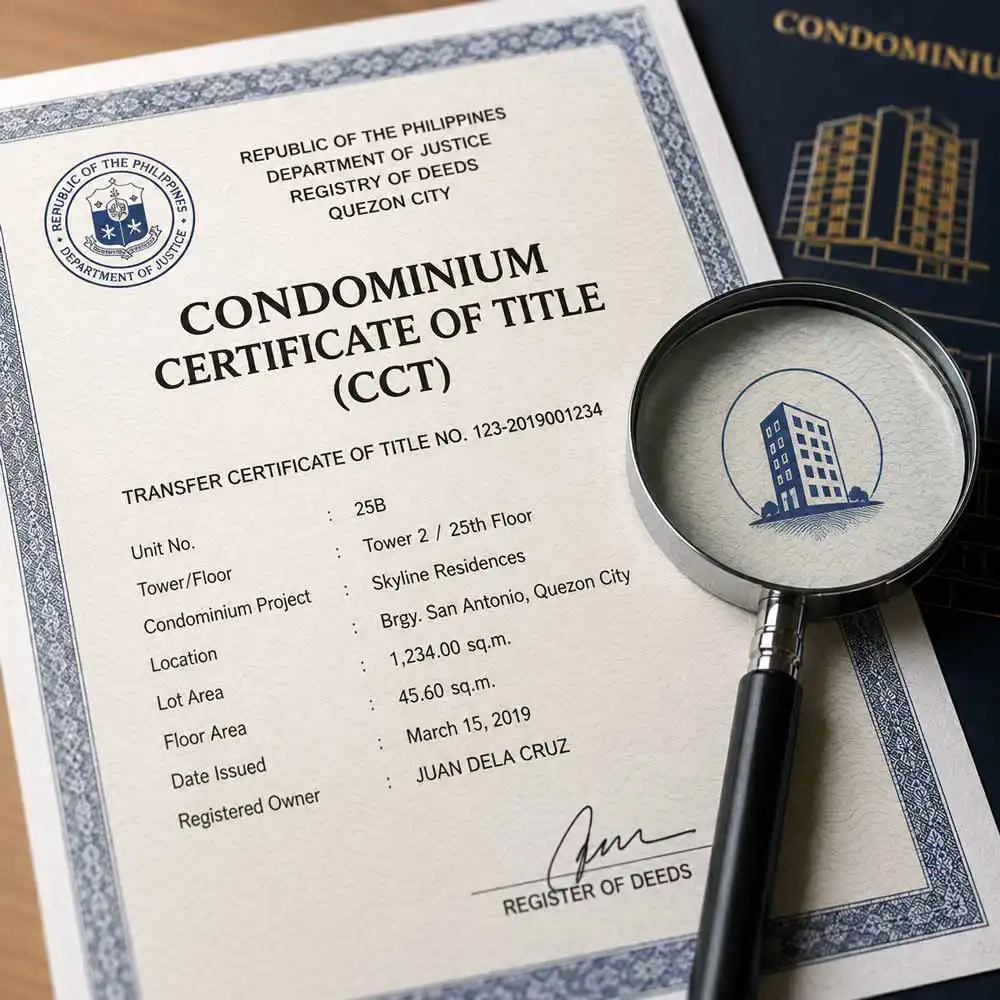
For resale purchases especially, always ask for a certified true copy of the CCT from the Registry of Deeds and check it for existing liens, mortgages, or unpaid association dues before you pay a centavo. A clean CCT is non-negotiable — it’s the single document that protects your ownership claim.
3. How the Condo Corporation Works
Every registered condominium project is required to form a condominium corporation under the Condominium Act (Republic Act No. 4726). The moment you acquire a unit, you automatically become a shareholder-member of that corporation — you can’t opt out, and your voting share is proportional to your unit’s percentage interest in the common areas.
The condo corporation, through its elected board, manages shared spaces like hallways, elevators, and amenities, enforces the Master Deed and Declaration of Restrictions, and collects the association dues that keep the building running. If the developer is slow to turn over the amenities and hand control to the corporation, that’s worth asking about directly during your due diligence.
4. Condo Association Dues: What You’re Really Paying For
Association dues are the monthly (sometimes quarterly) fees that fund building maintenance, security, utilities in common areas, and reserve funds for repairs. They’re calculated based on your unit’s share of the common areas as defined in the Master Deed — bigger units generally pay more.
Under the Magna Carta for Homeowners and Homeowners’ Associations (RA 9904), dues generally cannot jump by more than 10% a year without majority owner approval. Miss payments, and the corporation can register a lien against your CCT and eventually pursue foreclosure under Section 20 of RA 4726 — a lien that follows the unit, not the person who racked it up, which is exactly why resale buyers should confirm a seller’s dues are fully settled before closing. As a budgeting example, a unit with ₱4,000 in monthly dues adds roughly ₱48,000 a year to your true cost of ownership, on top of real property tax.
5. Taxes You’ll Pay When Buying a Condo
Closing costs in a typical Philippine condo purchase run about 4–7% of the property value, though this can climb higher if VAT applies. Here’s the usual split:
- Documentary Stamp Tax (DST): around 1.5% of the selling price or the government valuation, whichever is higher — customarily shouldered by the buyer.
- Local transfer tax: roughly 0.5% to 0.75%, paid to the city or municipality where the unit sits.
- Registration fees: a sliding scale of about 0.25% to 0.5%, paid to the Registry of Deeds.
- Capital Gains Tax (6%) or, for developer/ordinary-asset sales, Value-Added Tax (12%) plus creditable withholding tax — these usually fall on the seller, but VAT is often already built into a developer’s listed price.
- VAT threshold: under BIR Revenue Regulations No. 1-2024, house-and-lot or condominium sales above roughly ₱15,000,000 (and residential lots above ₱3,600,000) can trigger VAT, so higher-ticket units deserve a closer look at how the price is structured.
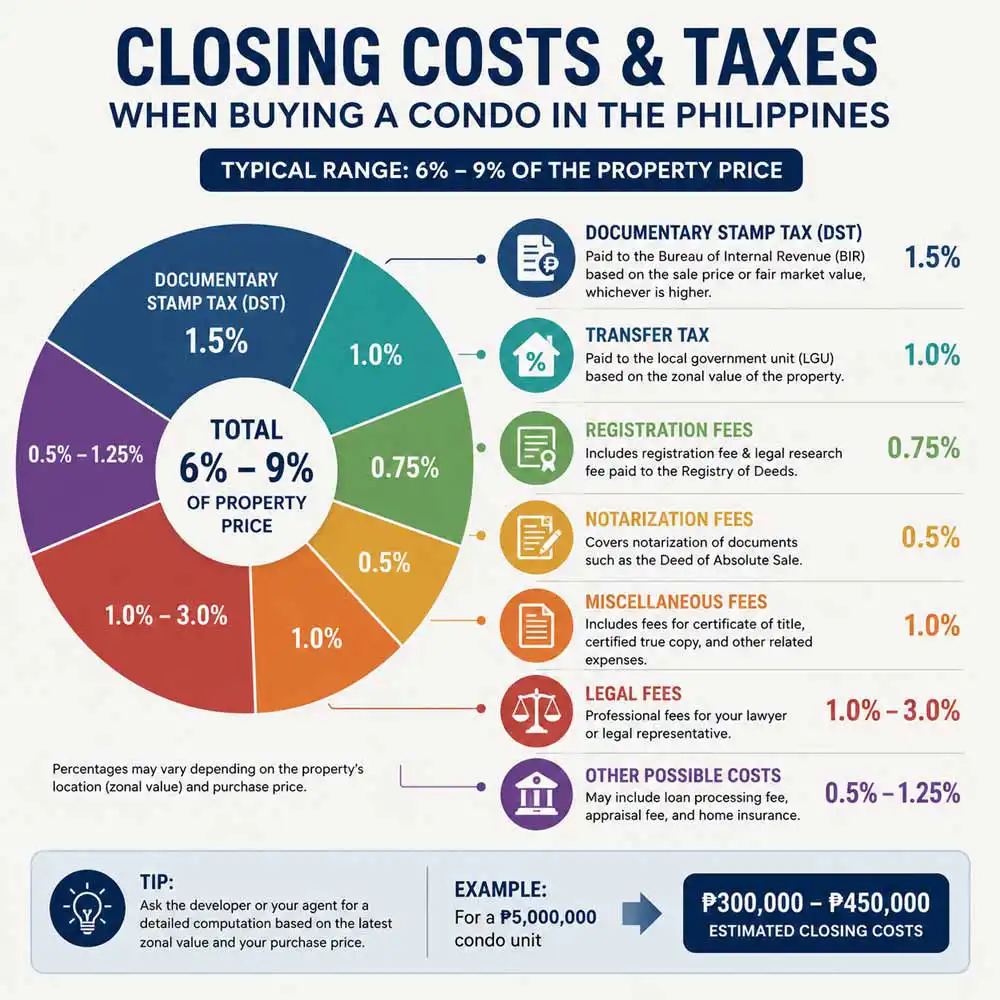
Always ask whether a quoted price is VAT-inclusive, and get the tax allocation in writing in your Reservation Agreement or Contract to Sell.
6. Financing: Bank Loans, Pag-IBIG, or In-House
Most buyers choose between a bank housing loan, a Pag-IBIG Fund loan, or in-house financing offered directly by the developer. Bank loans in 2026 generally carry fixed rates in the upper-5% to lower-6% range for the first one to five years, while Pag-IBIG offers government-subsidized rates as low as 3% for qualifying socialized and economic housing under its Expanded Pambansang Pabahay para sa Pilipino (4PH) Program, alongside a standard track that runs higher for longer fixed terms.
Pag-IBIG’s loan ceiling (around ₱6 million as of 2026) makes it a fit mainly for mid-market units, so buyers eyeing higher-end Metro Manila condos will usually need a bank loan instead. OFWs can apply for both bank and Pag-IBIG loans through an authorized representative using a Special Power of Attorney — more on that in item 10.
7. Condo Rental Yield: What Landlords Actually Earn
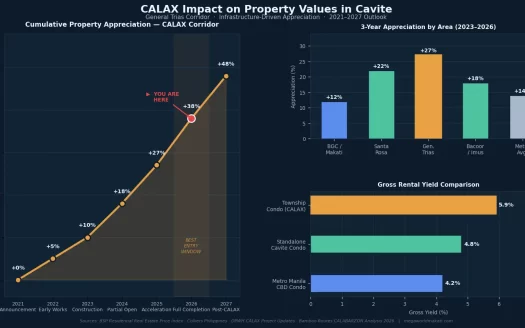
Rental yield measures your annual rental income as a percentage of the property price. The average gross rental yield across the Philippines stood at 5.11% in the first quarter of 2026, according to Global Property Guide’s biannual analysis — but that number hides big swings by location.
Prestige addresses like BGC’s prime core, Rockwell Center, and Salcedo Village tend to compress toward 3.5–4.5% net yield because purchase prices have run far ahead of achievable rents, while mid-market submarkets such as Quezon City’s Araneta City-Cubao corridor or Mandaluyong post stronger figures thanks to steadier tenant demand. Analysts at Colliers Philippines and Metrobank Wealth Insights both flagged Metro Manila residential vacancy hovering around 25–26% through 2025–2026, so factor realistic vacancy — not just headline rent — into any yield calculation before you buy for investment.
8. RPPI: Reading the Bangko Sentral’s Price Index
The Residential Property Price Index (RPPI), published quarterly by the Bangko Sentral ng Pilipinas, tracks how housing prices are actually moving based on real bank loan data — replacing the older RREPI methodology starting in 2025. In the fourth quarter of 2025, the nationwide RPPI rose just 1.6% year-on-year, the slowest pace since the first quarter of 2019, though condominium prices specifically still climbed 3.5% even as house prices nearly stalled at 0.1%.
The market showed signs of a turnaround in the first quarter of 2026, with the index rebounding 5.6% quarter-on-quarter nationwide as NCR prices jumped 10.4% from the previous quarter. The nationwide median condo price stood at about ₱4.72 million in Q1 2026, with NCR units running highest at roughly ₱5.32 million median — numbers worth checking against any unit you’re considering to see if you’re paying above or below the going market rate.
9. BIR Zonal Value and the New Valuation System
For decades, the BIR’s “zonal value” was the government benchmark used to compute capital gains tax and documentary stamp tax whenever it exceeded the actual selling price. That changed with Republic Act No. 12001, the Real Property Valuation and Assessment Reform Act (RPVARA), signed in June 2024, which shifts valuation authority to local government assessors using a uniform Philippine Valuation Standard and a single Schedule of Market Values (SMV) per locality.
In practice, this means the BIR is being phased out of setting its own zonal values, and your tax base will increasingly be anchored to your LGU’s updated SMV instead. Ask your broker or the local assessor’s office for the current valuation figure for your specific unit before you finalize your budget — this number can materially change your DST and CGT exposure.
10. SPA: Buying Remotely as an OFW
A Special Power of Attorney (SPA) or SPA for OFW property buyers lets a trusted representative in the Philippines sign on your behalf — the reservation agreement, the Contract to Sell, the Deed of Absolute Sale, even loan documents — if you can’t be physically present. Property-specific SPAs that name the exact unit and clearly list every authorized action are strongly preferred over broad, catch-all powers, since banks, the BIR, and the Registry of Deeds can reject vague authorizations outright.
If you’re signing abroad, the SPA needs to be notarized locally and then either apostilled (for countries under the Hague Apostille Convention) or authenticated at the nearest Philippine Embassy or Consulate before it’s valid for use back home. Start this process early — authentication alone can take two to four weeks, and a delayed SPA has cost more than one OFW buyer their reserved unit.
11. Remaining Inventory Life: A Buyer’s Leverage Signal
Remaining inventory life (RIL) is a Colliers Philippines metric estimating how many years it would take to sell off all currently unsold condo stock at the prevailing sales pace. It’s a useful proxy for how much negotiating leverage buyers have in a given market — the longer the RIL, the more inventory developers are sitting on, and the more room there typically is for discounts, freebies, and flexible terms.
Metro Manila’s RIL fell to 6.8 years in the first quarter of 2026, down sharply from a peak of 13.4 years in mid-2025, as preselling take-up surged 765% year-on-year on the back of stronger demand in the economic and affordable segments. A shorter RIL trend generally signals the market is tightening — a sign that promotional pricing and generous payment terms may not last.
12. DHSUD License to Sell: The Regulator You Should Check Before You Pay
The Department of Human Settlements and Urban Development (DHSUD) is the government agency that registers and licenses every subdivision and condominium project in the country under Presidential Decree No. 957, the Subdivision and Condominium Buyers’ Protective Decree. A developer legally cannot sell, market, or collect payments for units in a project without first securing both a Certificate of Registration and a License to Sell from DHSUD.
Before you hand over a reservation fee, contact the DHSUD regional office covering the project’s location, or check its published list of licensed projects, to confirm the development is registered and in good standing. This single step is one of the cheapest, fastest ways to protect yourself from stalled or fraudulent projects.
13. The Condominium Act (RA 4726) in Plain English
Republic Act No. 4726, the Condominium Act of 1966, is the foundational law defining what a condominium is under Philippine law: a separate ownership interest in your unit, combined with an undivided interest in the land and common areas, typically held collectively through the condominium corporation. It’s this legal structure that lets foreigners own condo units directly even though the 1987 Constitution generally bars them from owning land.
Under the Act, foreign ownership across all units in a single condominium project is capped at 40% of the total floor area, with the remaining 60% reserved for Filipino citizens or Filipino-controlled corporations. If you’re a foreign buyer, ask your broker for the building’s current foreign-ownership percentage before you reserve — projects that are already near the cap may not be able to process your purchase.
14. Loan-to-Value Ratio: How Much a Bank Will Actually Lend
The loan-to-value (LTV) ratio is the percentage of a condo’s appraised value that a bank is willing to lend you; the rest is your down payment. Philippine banks commonly offer Filipino borrowers an LTV between 60% and 90% depending on the lender, the borrower’s credit profile, and whether the unit is RFO or still pre-selling, while foreign buyers typically see a narrower band of roughly 50% to 70%.
A higher LTV means a smaller down payment, but it usually comes with a higher interest rate and, in some cases, mandatory mortgage insurance. Run the numbers both ways — a lower LTV with a bigger down payment often saves more in total interest over a 15- to 20-year loan term than the smaller initial outlay is worth.
15. Final Checklist Before You Sign
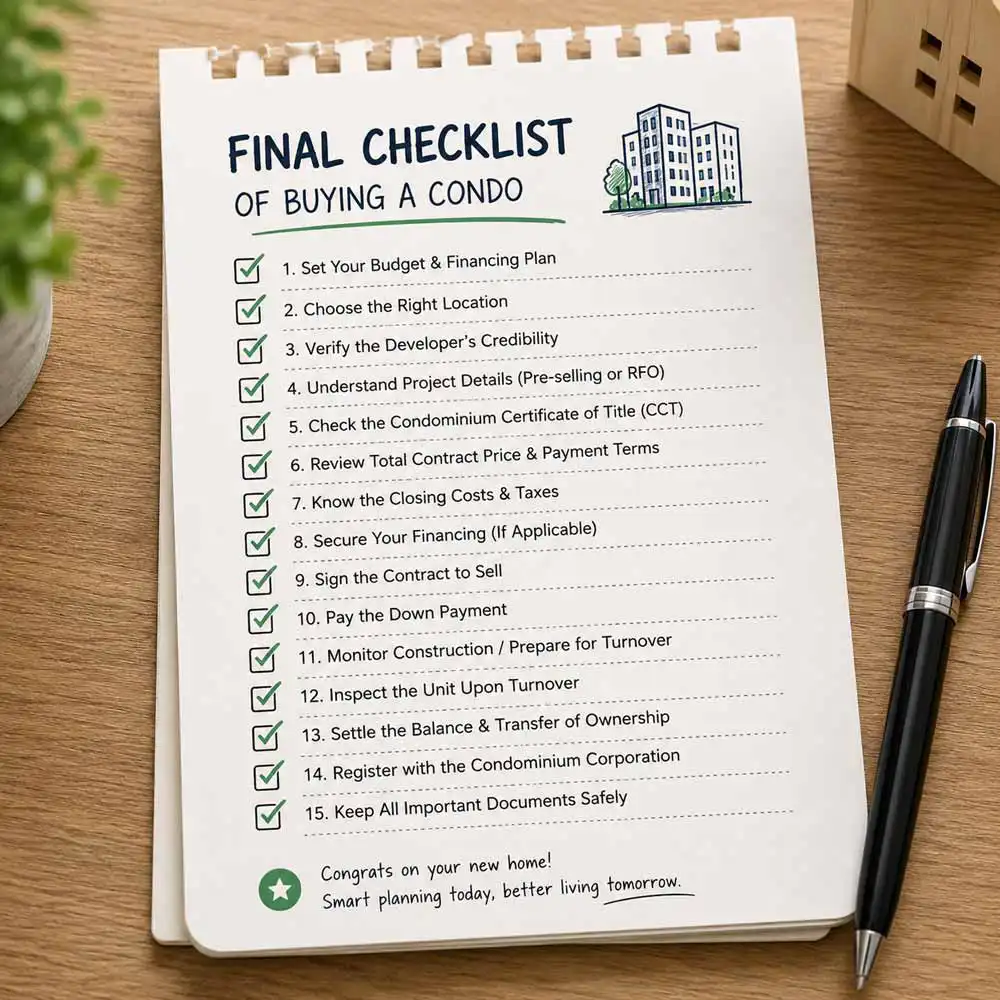
Before you commit to buying a condo in the Philippines, run through this checklist:
- Confirm the project’s DHSUD Certificate of Registration and License to Sell.
- Request a certified true copy of the CCT (for resale units) and check for liens.
- Read the Master Deed and Declaration of Restrictions — know the house rules before you buy.
- Get the current association dues rate and any pending special assessments in writing.
- Confirm whether the quoted price is VAT-inclusive and who pays which closing taxes.
- Get pre-qualified for financing — bank, Pag-IBIG, or in-house — before reserving.
- Check the building’s foreign-ownership percentage if you’re a foreign buyer.
- Prepare and authenticate your SPA early if you’re buying from abroad.
- Compare the unit’s asking price against current RPPI and zonal value/SMV data.
- Walk the actual unit or request a live video walkthrough before final payment, whenever possible.
Can foreigners buy a condo in the Philippines? Yes. Foreigners can own condominium units directly, as long as total foreign ownership within a single condominium project doesn’t exceed 40% of the total unit area, per the Condominium Act. Foreigners still cannot own the land beneath a condo project, which is why ownership is structured through the condominium corporation instead.
How much are the total taxes and fees when buying a condo in the Philippines? Buyers should typically budget 4% to 7% of the property price for documentary stamp tax, local transfer tax, and registration fees, with the exact mix depending on whether the seller is an individual (capital asset, CGT-based) or a developer (VAT-based). High-value units above roughly ₱15,000,000 may also carry VAT exposure.
What’s the difference between pre-selling and RFO condos? Pre-selling units are purchased before or during construction at a lower entry price with flexible in-house terms, but carry construction-delay risk. RFO (ready-for-occupancy) units are complete and titled, cost more upfront, but let you move in or start renting immediately.
Do I need to be in the Philippines to buy a condo as an OFW? No. OFWs and Filipinos abroad can complete a purchase remotely using a properly authenticated Special Power of Attorney (SPA), which authorizes a trusted representative to sign the reservation agreement, contract to sell, and deed of sale on their behalf.
How do I check if a condo project is legitimate? Verify the project’s DHSUD Certificate of Registration and License to Sell through the DHSUD regional office covering the project’s location, or its published list of licensed projects, before paying any reservation fee.
The Bottom Line
Buying a condo in the Philippines rewards buyers who do the paperwork homework upfront — verifying DHSUD registration, understanding your CCT and association dues obligations, and locking in financing before you fall for a model unit. None of the 15 items above are deal-breakers on their own, but skipping any of them is how buyers end up with unwelcome surprises at turnover.
If you’re weighing a pre-selling or RFO unit in Metro Manila and want a second set of eyes on the numbers — financing, projected rental yield, or the fine print in a Contract to Sell — Ms. Jeraldine Tan, Senior Sales Director at Megaworld Alpha, is available for a no-pressure consultation at +63 917 899 2486 or tanjeraldine@gmail.com.